
Chicago Sun-Times Candidate Questionnaire: Nick Uniejewski for Il Senate 6th District
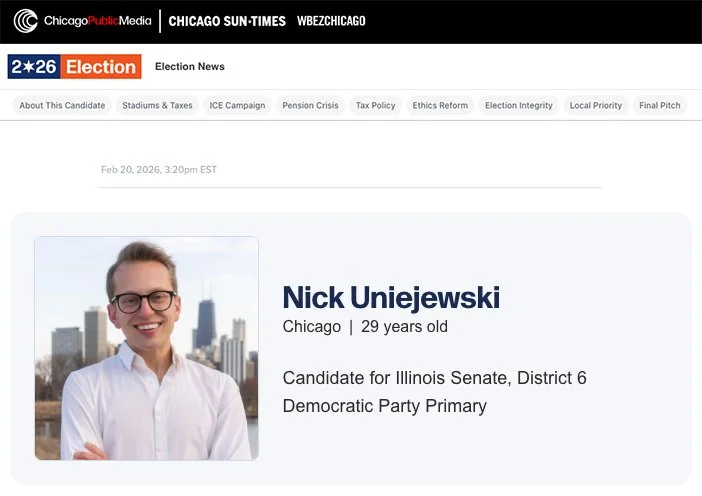
To inform voters, the Chicago Sun-Times and WBEZ asked candidates to respond to questions about key issues. Answers are limited to 500 words per question and have been lightly edited for typos, minor grammar and consistency in styling, but not for content.
Read the questionnaire in full at the Chicago Sun-Times or see Nick’s answers below.
Stadiums & Taxes
Q: The Chicago Bears recently suggested Northwest Indiana as a potential venue for a new stadium. However, in their pursuit of a new stadium in Arlington Heights, the Bears have previously wanted the Illinois General Assembly to pass legislation that would freeze property tax assessments for large-scale projects such as the stadium megadevelopment, at a discount negotiated with local taxing bodies. Would you support such legislation? Please explain why or why not.
Uniejewski's Response
No. I do not support using state tax policy to subsidize a new Bears stadium. While Soldier Field is publicly owned, any new stadium or major redevelopment proposal is still a public-private deal that concentrates benefits with a professional sports franchise while shifting financial risk onto taxpayers. Freezing or discounting property tax assessments for a megadevelopment like a Bears stadium would inevitably push costs onto homeowners, renters, and small businesses at a time when many are already being squeezed by rising housing costs. Illinois is still paying off the public debt from the early-2000s Soldier Field renovation, with bond payments extending decades later. That reality makes it even harder to justify new tax concessions or subsidies for another stadium project, regardless of ownership structure. Taxpayers should not be asked—again—to underwrite deals where the returns are speculative and the obligations are long-lasting. State resources should be directed toward clear public goods: replacing lead service lines, modernizing and expanding public transit, strengthening public health infrastructure, and ensuring access to care. Those investments deliver measurable, long-term returns for communities across Illinois. We also have examples that show a different path is possible. The Chicago Fire have pursued a new stadium and surrounding development using private investment, demonstrating that economic growth does not require public giveaways. That model protects taxpayers while still allowing development to move forward. The General Assembly’s responsibility is to be a careful steward of public dollars and make decisions guided by evidence, fiscal responsibility, and equity—not to provide special tax treatment for powerful interests simply because they ask.
ICE Campaign
Q: There have been major concerns in Chicago and surrounding suburbs about how the Trump administration has implemented its Operation Midway Blitz campaign. What is your view of the campaign and its execution, and what do you think Illinois should do to address concerns about the ongoing operation?
Uniejewski's Response
Operation Midway Blitz, as carried out by the Trump administration, has been an abuse of federal power that has traumatized Chicago communities—especially immigrants and their families. The use of masked and unidentified federal agents, militarized crowd-control tactics, and intimidation of journalists and community members has no place in a democratic society. My roots are in organizing, and organizing means more than issuing statements after the fact—it means showing up and putting your body on the line when your neighbors are under attack. I have done that. I was pepper-balled by federal agents while peacefully protesting outside the Broadview ICE facility last year. Seeing weapons of war turned on civilians and peaceful demonstrators—including faith leaders and legal observers—made clear how urgent this moment is. We are not in normal times. Illinois can not rely on court orders or temporary pauses in enforcement. We must act boldly through state law. That includes mirroring California’s recent law requiring transparency and identification when federal agents operate in Illinois. We should also significantly invest in legal defense, rapid-response networks, and trauma-informed services for families impacted by these raids. The harm inflicted by these operations does not disappear when enforcement pauses—it lingers for years. If we are serious about defending immigrant communities, we must be willing to confront federal overreach directly and codify protections so they can not be swept aside by the next administration. Democrats can not claim to stand with immigrants while staying silent when abuses occur in our own neighborhoods–including Lincoln Park, Lakeview, and North Center. Illinois should lead with courage, clarity, and action—and I am running to be the kind of state senator who understands the urgency of this moment and is willing to fight day and night for our most vulnerable neighbors.
Pension Crisis
Q: Illinois' longstanding pension crisis continues to hamper job growth, turn away prospective new employers, and derail the state's long-term economic stability. In your opinion, what course should Illinois take to solve the pension crisis?
Uniejewski's Response
Illinois’ pension crisis demands solutions that are fiscally responsible, grounded in evidence, and focused on the future, not short-term fixes. First, we must honor our obligations. Public employees earned their pensions, and protecting retirement security is non-negotiable. Second, Illinois must modernize how government operates. With more than 7,000 units of government, we have layers of duplication that drive up administrative costs. For example, when Evanston voters dissolved Evanston Township a decade ago and folded its functions into the city, taxpayers saved nearly $780,000 in the first year alone, largely through reduced administrative and staffing costs. My own work in Chicago city government modernizing programs using research, data, and community input showed that streamlining can deliver better outcomes with limited resources. Third, we can not simply tax our way out of this crisis. Illinois needs bold structural revenue reform: stabilizing property tax formulas and limiting loopholes, reducing reliance on regressive taxes, and adopting a graduated state income tax so those with the greatest ability to pay contribute fairly. Finally, pension investment policy itself matters. I support repealing a state law my opponent sponsored that requires the Illinois Investment Policy Board to place companies that boycott Israel on a restricted investment list. This repeal would not mandate divestment or direct investments; it would simply restore fiduciary discretion so pension boards can make decisions based on financial performance, risk management, and long-term stability, rather than political mandates written into statute. How we invest public pension funds is also a moral question. At a moment when there is a genocide in Gaza and widespread concern about human rights violations, Illinois should not force its pension systems to ignore human rights risks or limit responsible investment options. Pension funds exist to protect workers’ retirements—not to advance political litmus tests that can undermine returns and ethical accountability. According to publicly cited estimates, this law has cost the pension system roughly $149 million in lost returns over the last decade. Solving the pension crisis requires honoring workers, modernizing government, reforming revenue, and restoring responsible, evidence-based investment authority. That is the bold, structural change Illinois needs.
Tax Policy
Q: Are there any scenarios in which you would support increasing the state income or sales taxes?
Uniejewski's Response
I hesitate to raise sales taxes because working families are already being nickel-and-dimed for everything under the sun, while wages have largely stagnated. Sales taxes are regressive, hitting those with the least ability to pay the hardest, and they are not the right tool for long-term fiscal stability. I do believe, however, that a graduated state income tax is the fairest way to raise revenue. It ensures that those with greater means contribute their fair share while protecting low- and middle-income families. Any increase in revenue should be paired with bold structural reforms—modernizing government, consolidating unnecessary agencies, and streamlining services—so that every dollar collected is spent efficiently and transparently.
Ethics Reform
Q: Former Illinois House Speaker Michael Madigan was found guilty of conspiracy, bribery and wire fraud and sentenced to 7 ½ years in prison. What additional specific ethics reforms need to be enacted in Illinois to discourage this type of political corruption?
Uniejewski's Response
The pay-to-play model that led to Michael Madigan’s corruption is part of the old way of doing politics, and it must be eradicated from Illinois government—regardless of party. Government works best when it reflects the needs and priorities of communities, not the interests of corporate donors. That has been the guiding principle of my career as an organizer, and it’s the reason I am running a 100% grassroots campaign, without taking money from corporations. My opponent, by contrast, is nearly two-thirds funded by corporate donors–including Big Pharma, hospital networks, energy companies, and agencies she is supposed to regulate. Government can not work for people if it is controlled by the very entities it is meant to oversee. We need comprehensive reform to prevent this kind of corruption. That includes: - Getting corporate money out of politics through publicly financed campaigns so candidates can run based on ideas, not whoever has the wealthiest network. - Ranked-choice voting, which ensures every vote counts and empowers voters rather than entrenched interests. - Term limits, to bring new perspectives and fresh ideas into government and reduce opportunities for entrenched power and patronage. - Strengthening transparency, accountability, and enforcement so misconduct is detected early and punished consistently. These reforms needed are structural. Only by combining all of these measures can we create a government that is truly rooted in compassion, powered by the community, and staffed by people who want to serve the public, not cling to power.
Election Integrity
Q: Illinois' system of counting mail-in ballots is facing a challenge before the U.S. Supreme Court. What additional steps are necessary to safeguard the integrity of state elections?
Uniejewski's Response
My roots as an organizer shape how I think about safeguarding Illinois elections. In 2020, I worked with Indivisible to coordinate an information campaign about mail-in voting at the height of the pandemic. That grassroots effort helped voters navigate the system safely and contributed to the successful election of Joe Biden. Experiences like that show me that protecting the right to vote requires on-the-ground, people-powered work, not just legislation. Illinois must continue to empower local election agencies, including the Chicago Board of Elections and the Illinois State Board of Elections, with the resources to meet voters where they are—through mail, phone, or community outreach. Funding, training, and support for year-round organizing and voter education are critical to making our elections accessible, transparent, and secure. We also have to combat disinformation. False claims about mail-in ballots and voting processes undermine trust in our democracy and depress participation. That’s why it’s essential for the state to take proactive steps to educate voters and enforce existing election laws. While protecting elections is fundamentally nonpartisan, we can not ignore that certain national actors, aligned with the MAGA movement, have shown they are willing to undermine voting rights for political gain. Illinois Democrats must be vigilant, proactive, and unafraid to throw a punch—both against federal attacks on democracy and against any local status quo that underestimates the threats we face.
Local Priority
Q: What is the most pressing problem in your district, and what is your approach to solving that problem?
Uniejewski's Response
The most pressing problem in our district is housing. We face a two-part crisis: people who want to buy homes can’t because the housing stock doesn’t exist, and long-time renters and homeowners are being priced out of neighborhoods we love, whether due to skyrocketing property taxes—some up more than 100% in the last year—or ballooning rents. Over 300,000 housing units are missing across Illinois, and this shortage affects cities from Chicago to Champaign, Rockford, and beyond. At the state level, we need to use every tool available. That starts with zoning reform: legalizing four-flats, coach houses, and other diverse housing types statewide would expand options in high-demand neighborhoods. We also need property tax reform. Many long-time residents are being priced out despite existing caps and exemptions, while commercial properties often avoid paying their fair share. Enforcing the laws we already have and creating predictable formulas for property taxes and rent increases—such as indexing increases to inflation—would protect residents from being squeezed. We also need to lower the cost of construction. Many building codes are outdated by decades, driving up costs unnecessarily. Modernizing these codes—while keeping safety and climate standards—can make new housing more attainable. Cities across the country, from Seattle to New York, and states like Montana and Texas, have successfully implemented similar reforms on codes such as staircases or elevators. Housing is not just a policy problem; it’s a community issue. Families in Lakeview, Lincoln Park, North Center, and across the North Side are leaving for the suburbs simply because they can not find homes that meet their needs. I have heard this directly from neighbors during our campaign, after knocking on over 55,000 doors across the district. I will be a fighter for housing in Springfield. The state can no longer sit on task force reports and do nothing. Illinois needs bold solutions, predictable rules, and leaders willing to act. I am ready to deliver on all three.
Final Pitch
Sum up why you believe you are the better candidate for this office.
Uniejewski's Response
We need better Democrats in Springfield—leaders willing to throw a punch at a system that has grown too comfortable serving donors, insiders, and corporate interests while working people are told to wait their turn. Voters are tired of it—and they’re right to be. Illinois has a full Democratic supermajority: The House, the Senate, and the Governor’s office are all Democratic. Yet issues like unaffordable housing, rising health care costs, and government inefficiency persist. It’s not a question of needing more Democrats—it’s about having better Democrats: leaders who actually listen to people, fight alongside them, and are willing to throw a punch when the status quo fails us. Contrast that with my opponent, who has been in office for over 30 years without ever facing a primary challenger. She has not been present in the community, she is not passing legislation at the level of other legislators across the region, and she approaches governing by polling before she acts instead of standing with conviction. I thank her for her service, but it’s time for something new. Illinois needs leaders who fight hard for our immigrant communities, as we have seen people kidnapped by ICE in Lincoln Park, Lakeview, and North Center. We need leaders who take on insurance companies that deny gender-affirming care or prescriptions. We need leaders who will unapologetically fight for our most vulnerable neighbors. I am running because I bring that organizer energy into everything I do. I work year-round alongside neighbors—knocking on doors, biking through neighborhoods, sharing information on TikTok, and showing up where people live and work. I am also a real person in the community, enjoying our bars, restaurants, and lakefront, but above all, I love the people I plan to serve. This moment doesn’t call for incremental change. It calls for new energy, new leadership, and a fighter for the 6th District—someone willing to throw a punch for housing, health care, and equity, and finally make government work for the people.